Friday, May 13, 2016

Acculturation of Chinese-Indonesian Culture in Indonesian Society, Part One Art


There has been a lot written about conflicts between Chinese and other Indonesians (a.k.a. pribumis) but I would like to explore the idea of acculturation or the cultural adaptation that has occurred through the contact between Chinese and Indonesian cultures.

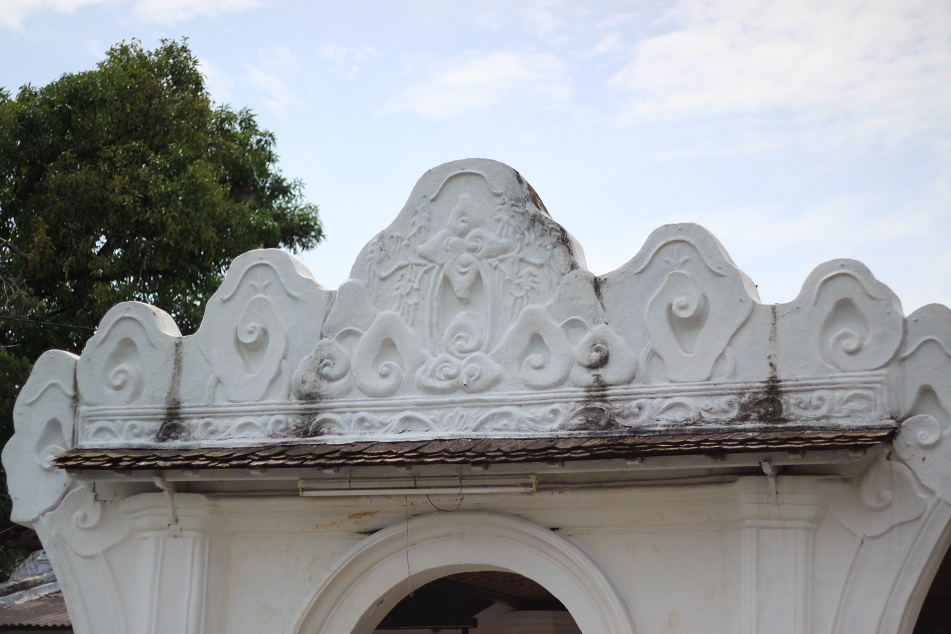
Firstly, the process of artistic influence. As Chinese-Indonesians came to live and trade on the north coast of Java (a.k.a. pasisir region) they influenced the style of art used, for example the style of mega mendung (rain clouds).


This style can be seen at Keraton Kesupuhan (the former royal residence of the Cirebon sultan) in Cirebon, Java on the walls.


 Mega mendung is influenced by the Chinese concept of 'lucky clouds' which are often associated with Chinese mythology and divine figures considered to bring blessings.

It can also be seen on many pasisir batik clothes.
Another thing you can see here in this image is the use of dragons, considered to be benevolent in Chinese culture, represented as one of the 12 zodiac figures.

(You can find several more of these images on the SMP Prosit site)

Sunday, December 22, 2013

Double Translation Language Learning Method

Hey all, it's been some time since I put up a post but I decided to as I think this is a good method for learning other languages (Double Translation Method).

This is a language learning method one which is used by Assimil (language courses company from France) and has been used in previous centuries as well.

What we do is take a phrase from a foreign language:Bugün, hava bir güzel(Turkish) and then we will translate it in English literally.
Bugün - This-day (compound word), hava - weather, bir - a/one, güzel- beautiful.
Now we have this-day, weather a beautiful.
Notice how Turkish lacks the article 'the' and uses the word for 'one/a' to represent is in this sentence.

Next, put it into better English: Today, the weather is beautiful.
Now what I would do is to take the words that I have translated literally and translate it back into Turkish without looking at the original.

What this method teaches us is to think in the syntax (the way words relate to each other in a sentence) of the other language so we can move away from thinking in the structure of our native language to the language we are learning.

Thursday, August 15, 2013

Dom Talks about Jesus

I grew up semi-Catholic and have been questioning my relationship with Christianity, Jesus, etc. ever since then

Dealing with experiences with involvement with evangelical Christianity and missionaries a few years back pushed me to the point where I felt I had to prove Christianity was wrong,
I used to read up on a site called Jews For Judaism to prove that the teachings were wrong, Jesus was not the messiah, etc. etc.

Over the past year or two I've been looking at esoteric representations of Jesus,  Jesus in Espiritismo (from Puerto Rico and Cuba) and Spiritism (the codified doctrine of Allan Kardec), gnostic Jesus. Something has definitely clicked, I feel that Jesus represents something powerful, not the Jesus who holds the real and only keys to salvation, but still powerful, the Jesus that connects to each of us.

I respect Judaism as a religion which asks people to be just but I've felt that the emphasis on roles between Gentiles and Jews is distracting from the true face of God that connects to all of us.
I can read and enjoy Kabbalah seeing it as fulfilling yet ultimately something that needs to be seen less as a fulfilment of only practitioners of Judaism but as something which connects to each of us (esp. in Hermetic/Christian C(Q)abalah).

Understanding the Bible for me is about looking at esoteric and hidden meanings, it takes one step for 'good Christians' to look at how the Old Testament leads to Christ through allegories but another to see Christ within each of us that we are "sons(and daughters) of God".

The Jesus that came back from the cross was a spiritual body and not a physical one (as stated in docetism, and Kardec's Spiritism).

Sunday, August 4, 2013

Hermeneutics and Interpretation of Religious Texts


Interpreting religious texts is quite a varied approach, hermeneutics is the way we approach and interpret these texts (philosophical texts too).

Hermeneutics comes from the Greek "hermēneutikos - (an) expert in interpretation".

The major approaches to interpreting religious texts I have been looking into are:
  • Religious interpretations: Christian (Orthodox, Catholic, Evangelical...) and other religions which interpret texts in accordance with their dogmas and revealed beliefs, to read through divine revelation.
  •  
  • Historical interpretations: Historians explore religious texts through looking into the possible religious influences into that text (external or internal), whether there are political contexts that may affect the readings (i.e Book of Revelations in reaction to events in the Roman Empire).
  •  
  • Esoteric interpretations: Kabbalistic interpretations using gematria or a numbering system that uses the Hebrew (Imperial Aramaic) script to interpret words thereby giving secret meanings. Hidden meanings of words and texts understood by mystics/esotericists serve to further direct this understanding or interpretation.

Sunday, June 23, 2013

Volunteering Overseas to Teach Theatre

So, I've been thinking about volunteering to teach theatre overseas and I've been focusing on two places:
Brazil and the Philippines. Both places have volunteer theatre programs, I admit the Philippines has a specific program which is connected to the local traditional theatre and that would be special.
But honestly I really want to go to Brazil, so I do intend to save up to travel there. The thing is though with the flight expenses it won't be easy going to Brazil (3500-4000 in total for the complete journey).
So, I've been looking at various options: doing crowdfunding or getting a grant
Crowdfunding is a new way to save up by putting your project on the internet for others to chip in. Considering, my present situation means that I may be studying sound production this year and I'm not too sure about the time periods writing a specific advertisement for funding doesn't sound so good at the moment. So, I'm left with working which hasn't been going anywhere even though I've been putting in an average effort because I'm not too fussed about what I've been applying for.

Confusing situation, eh?


Wednesday, May 29, 2013

Finding a Sense of Community and Identity

I've been debating community, identity, tradition and modernity in today's world.

Firstly, living in a modern Western society (Australia) ensures that I am free to be an individual, free to define my own journey. Of course peer pressure is relevant here and we do have expectations from ourselves and from others around us but in a different way to other societies.

We want meaning, we want to define where we stand, find out whether we fit or don't fit.

Recently, I read a book which relates to these issues by Robyn Bavati called 'Dancing in the Dark'. It is about the life of a young Haredi/Ultra-Orthodox Jewish girl living in a conservative family who wanted to become a ballet dancer (fictional yet based on a real individual). She faced difficult in doing this and had to lie about her other life and what Robyn does in this book is interesting, you would think she would condemn them and their ways but she shows that there is something about living in a Haredi community that can be fulfilling and that we as individuals are continually making choices to be where we are or to change directions and maybe the walls that limit us can be empowering for some people (giving them a sense of meaning and place-i.e Sara, Ditty's friend) but limiting for others (i.e Ditty, the main character).

I, as a Mauritian-Australian am constantly asking myself about my identity. My Creole culture (which was explored in an earlier post) is based on the interactions of slaves who lost their cultures and Europeans and other Mauritians and finding meaning in Creole identity, community is something that isn't really easy to work out. You can say it's our music or our involvement in religion (Catholic, Anglican, Evangelical and even Rastafarianism) but I don't see that as fulfilling for me as an individual. Growing up in Australia has definitely made me feel different from people in Mauritius, our culture here is not quite defined, it was about a specific British/Northern European heritage and that still plays a role (hence of course, use of the English language) but transitioning into a multicultural society has led us to ask what makes us Australian. And, I find that I don't personally connect to Australia's British heritage overly (although it has obviously influenced me) and modern civic, multicultural Australia hasn't developed the culture or symbols for me to connect with (on a deeper level) coming from my background.
Maybe, it's because I don't feel complete with my Creole heritage and the people around me with a strong cultural background can relate to cultures with stronger identities and traditions which can then interact with their Australian identity for a stronger, more complete one?

I am searching, spiritually and culturally to fulfil myself and find a greater sense of meaning that I can connect with. I do have good friends and having friends you can talk to is truly a sense of community. Family, forms another community and I do have many cousins (many overseas and interstate though) and I do feel I can connect with a few of them fairly well (e.g. Mum).
But because culture is so important to me, I feel that in places such as Brazil, Mexico and a few other Latin American countries have experienced cultural hybridity on a deeper level and can fulfil the aspects of both Creole and Australian cultures I find lacking. I can learn about Brazilian spirituality and connect it to the ancestor veneration of my Malagasy African heritage, the Catholic practices of other ancestors (e.g. religions such as Umbanda, Catimbo, Candomble in Brazil, Espiritismo and Santeria in Cuba). Indigenous and European heritages have meshed in Mexico where in Australia they have mostly remained separate (Day of The Dead).

Dominic

Monday, April 22, 2013

My New Life in Asia: East Meets West: Myths About Collectivism and Individual (re-post from other blog)

My New Life in Asia: East Meets West: Myths About Collectivism and Indi...:
This was a good read and shows how we think Eastern societies care more about the community but actually Western societies can be more caring! It shows that we make major assumptions about these two groups but they can actually be misunderstandings.

Monday, April 1, 2013

Slavery in the Indian Ocean


 Slavery in the Indian Ocean was focused on two trades:
  • The Islamic
  • European-Colonial

Undertaken by or in the direction of the Islamic world (the trade run by Zanzibaris is a good example of this, in fact Tippu Tib the sultan was notorious for his thousands of slaves). Examples of Islamic or Muslim-majority countries with African descended populations would be Yemen, Iraq, Iran, Turkey.

The trade undertaken in the direction of the European colonies (Mauritius, Reunion, the Seychelles, South Africa) as well as, of course, to the Atlantic colonies.

Slaves heading to European colonies were eventually integrated culturally and spiritually(though music such as Sega in Mauritius, Reunion and the Seychelles was continued) into those societies and those heading towards Islamic societies converted and eventually adapted to those societies while keeping some traditions (Zaar spiritualist cult* is an example as well as music such as Fann at-Tanbura).


These two slave routes were differentiated historically:

  •  The Islamic Indian Ocean slave trade was conducted from the early 9th Century to the 20th Century (the Sultanate of Oman as a historical maritime society played a role in this being heavily connected to Zanzibar, Tippu Tib was half Arab). Saudi Arabia stopped slavery in the 1960s (Sudan is another that has continued but I am only referring to Indian Ocean societies).
  • The European trade was conducted from the 16th Century to the 19th Century during the colonial period being firstly stopped by the British (trade stopped in 1807 while slavery itself stopped in 1833) then by the French (1848).


Note: I refer to cult in the academic sense and not the demeaning, pejorative sense, i.e a cult is a practice or group of practices relating to a specific theme/object of devotion, the cult of the dead, the cult of the Virgin Mary)

Monday, March 11, 2013

Review of Souvenir Play


Souvenir is a play based on the life of Florence Foster Jenkins, an eccentric of the early 20th century who believes in her non-existent ability to sing.


This play was directed by Peter J Adams and the Australian premiere was created by Stephen Temperley. It was performed at Chapel Off Chapel theatre in Prahran, Victoria.

It explores the relationship between Hart(Stephen McIntyre) and Lady Flo (Helen Noonan) leading up to her final performance at Carnegie Hall. I found both characters to be well played, McIntyre interacts well with the audience, adds a sense of jazz and comedy through his piano playing and monologues. Noonan embodies the character fully through her physical language and spoken language successfully building an eccentric performance. She reached the climax of her performance in the Carnegie Hall play, embodying a Spanish-singing maraca playing role with costume to match and adding her lack of tone to the laughing opera song. They both make use of rhyme in speech and song with success. I also found their voices to be representative of their social status, with Hart having a colloquial New Yorker accent while Lady Flo has an upper-class air in her speech, inserting French phrases, reminiscent of the Anglophile American speech (influenced by British English) of the beginning of the 20th century.

There are various moments of tension in the play: firstly, by Hart being disgusted with her singing and almost leading himself away to live a separate life. Secondly, Lady Flo comes to the realisation that her performance at Carnegie Hall is being laughed at and the two characters have to find their sense of trust again. Hart, sees Lady Flo as a source of financial support and is willing to mislead her through false promises to keep her confidence up.

Another point for their interpersonal relationship is Hart's own interests in music (jazz and the songs he has written) and Lady Flo's commitment to opera and older forms of music. Lady Flo belittles it at first but as their relationship builds Lady Flo intends to use Hart's music which Hart is scared of using at first (because of his personal embarrassment) but Hart gives in and Lady Flo performs it on Carnegie Hall to a full crowd.

Although this play was overall successful I do find fault with the over-emphasis on Hart as narrator and supporting character, I do feel that they crossed the line drawing emphasis away from Lady Flo. By Hart serving as narrator and supporting actor we need to be continually drawn into Lady Flo's life and by his role as supporting actor we can't let ourselves be overdrawn into his life.

Sunday, March 3, 2013

Sufi Muslim Philosophers


I will be exploring the Sufi school of Islam.

Islam is a religion was founded (or as Muslims say, revealed unto the prophet Muhammed) in the 7th Century of the Common Era(CE) or the First century of the Hijra according to the Islamic calendar. This religion emphasises the teachings of Muhammed as the last prophet of Islam.

Sufism refers to the esoteric or inner practice of Islam and includes orthodox or schools upholding Islamic law and practice as well as other schools which place a greater emphasis on faith and dedication to saints.
In regards to Sufi practice I focus on several key figures: Ibn Arabi, Rumi, Suhrawardi.
Of these Rumi would be best considered an upholder of orthodox sufi practice in that he upheld the practice of Islamic law while also focusing on the esoteric/inner (batin/batiniyya in Arabic) understanding of Sufi Islam. He is famous throughout the West for his poetry and tolerance towards other faiths, a faith based on love of God and others.

Ibn Arabi upholds Neo-Platonic doctrines such as emanationism or cosmic principles (divine attributes and names) emanating from God to humanity. Ibn Arabi holds the theory of the qutb or pole, a powerful being or presence who guides humanity. He then refers to different abdals or saints who guide humanity.  Even though Lapidus considers Ibn Arabi to stand in the middle ground (orthoprax), commitment to laws with an acceptance of gnostic (developing the personal connection to deity) practices such as meditation and similar exercises. Lapidus connects this nevertheless to the popular Islamic devotion to saints, praying at saints' tombs for blessings and guidance.

Suhrawardi impresses me in two ways: firstly: his doctrine of alam al-mithal or the Imaginal world/mundus imaginalis (in Latin) a spiritual world/plane where human beings can connect to God and gain divine understanding. It is a state comparable to the dreams we have which are felt as if they were real. Secondly, Suhrawardi takes a syncretistic approach (combining beliefs from various religions) incorporating aspects of Zoroastrian thought (the pre-Islamic religion of Iran). Suhrawardi, inherited (as did Ibn Arabi) a legacy from Ibn Sina (Avicenna, 12th Century Islamic philosopher) of emanationist, Neo-Platonic understanding incorporating hierarchies of angels (two in particular) connecting humanity to God.

Note: Neoplatonism is the school of thought appearing through the 3rd, 4th and 5th centuries CE. It expands on Plato's teachings regarding morality and cosmology (relating to the formation of the universe, specifically in regards to the soul, God, etc.).
Sources:
Lapidus, I (2012), Islamic Societies to the Nineteenth Century, 2nd, Cambridge University Press.

Thursday, February 14, 2013

Filipino Folk Catholic Article (You shall be as Gods)


Folk Catholicism is the definition for beliefs which grew out of the Catholic tradition but are not necessarily in line with Catholic dogma (a lot of them wouldn't be). It does show how the practitioners of Catholicism have incorporated beliefs from their own pre-Christian traditions and redefined other beliefs to suit their daily reality.

Dennis Villegas explores Filipino Folk Catholic tradition in this article:
http://dennisvillegas.blogspot.com.au/2010/08/you-shall-be-as-gods-culture-of-anting.html

I've noticed the similarities with Mexican Folk Catholicism, especially in his reference to 'La Santisima Trinidad' (the Holy Trinity), an essential aspect to the Catholic doctrine I grew up in.
Here's a repost of Curandero Guero's article on La Santisima Trinidad looking at a folk Catholic and multi-religious perspective on the Holy Trinity.
http://www.elcuranderoguero.com/blog/2012/06/04/Saints-Spirits-Sunday-The-Holy-TrinityLa-Sant%C3%ADsima-Trinidad.aspx

Thursday, January 17, 2013

Black Elk and Me: Spiritually Inspired and Questioning

Today, I've decided to write about an issue that comes up during my readings on spirituality (for me, specifically these have been Folk Catholic practice, witchcraft, Spiritualism and Espiritismo).

This issue is about being inspired by someone and then finding out that they later converted to another religion.
The questions I ask and I'm sure that many others do, too are:

  • Am I being misled?
  • Can I still draw inspiration from this person's teachings?
  • Am I even on the right path?
I've decided that even if that person has decided to take that path and has found fulfilment then there is nothing that I can really say to negate that person even if I disagree with their direction (as we seem to be along the same path).
I can still take inspiration from that person, as both they and I are connected to God, the Source (Brahman, Ain Sof, the Godhead, etc.) And for me obviously, spirituality is an inner journey, about finding out what I connect to.

The title of this post refers to Black Elk, author with John Neihardt of Black Elk Speaks. Black Elk has been quoted many times for his original American Indian/Native American spirituality. I am sure that many people do not realise the conversion he undertook towards the end of his life (to Catholicism). This does not take away from the fact that we can be inspired by his teachings but we should still be aware of his total religious journey. I've been inspired by several people who've later taken faith in Catholicism or Islam.

Further information:
Black Elk Speaks by John Neihardt: http://www.amazon.com/Black-Elk-Speaks-Premier-Edition/dp/1438425406/ref=pd_sim_b_9
Black Elk on Wikipedia: http://en.wikipedia.org/wiki/Black_Elk

Monday, January 7, 2013

Aramaic Language

This post explores the Aramaic language


Firstly, it is important to understand the context through which the language first developed:

Aramaic started as the language of the Aramaean people.
The Aramaean people were a Semitic-language speaking people (like Hebrew and Arabic) that lived in South-Eastern Anatolia (present-day Turkey) and present-day Syria from the periods of 1200 BCE  until the Islamic conquest in the 7th century CE. They practised a polytheist religion (meaning they believed in many gods and goddesses such as Atargatis, a goddess represented as a mermaid).
They were known for their trading ability and for being shepherds. They established their capital in Damascus, the present day capital of Syria. Their trading ability encouraged the use of the language as a lingua franca (common tongue),  leading to its use by a variety of people (Persians, Arabs Assyrians, Jews,  and others).
(NB. there has been a recent movement declaring Aramaean identity, I am still unsure of the continuous history of this group)

Now in regards to the language itself:

It is a Northwest Semitic language (just like Phoenician which is extinct and Hebrew which is still spoken),
Aramaic as being a language family or a group of closely related languages which at the same time are spoken of as versions of Aramaic (in parallel to the various forms of Chinese which are called dialects but can be languages as well)
the language is presently used in several contexts: liturgical and vernacular.
Liturgical relates to the use of a language in a religious context: for example, Aramaic has been used as one of the two key languages of Judaism, as Aramaic was spoken by the majority of Jews (as a first or second-language) throughout the Classical period.

It is also important to note its fame as the language spoken by Jesus, the key figure in the religion of Christianity.

Vernacular Aramaic refers to the contemporary and colloquial use of the language: Turoyo is a vernacular form of Aramaic spoken in Southeastern Turkey yet it is not used in the church (where Classical Syriac, the liturgical language is used).
The vernacular language is spoken by Assyrians/Chaldeans (in Iraq, Turkey as well as Sweden and other areas), Mandeans (a group from Iraq who believe in a Gnostic religion which holds John the Baptist as their chief religious figure), Arabs (in several towns in Syria such as Ma'aloula) and Jews (formerly living in Turkey and Iraq yet presently living in Israel although mainly spoken by an elderly population).

Now to a phonological understanding:
the key phonemes or basic units of sound which are distinct in regards to the English language are:
ḥ(Heth) which is similar the ch in the Scottish word loch or in the Jewish name Chaim.
(Sade),
a letter which is called an emphatic consonant where the airflow is stopped after the sound thereby creating a break between it and the next letter.

ʿ  (Ayin), is a very rare sound, the best way to explain its pronunciation is through showing the spoken example here(under the sound there is a play button to press). It is a voiced sound meaning the vocal chords, vibrate during the pronunciation of the sound.

Main alphabets used to write Aramaic:
Aramaic is written in the Hebrew alphabet, an alphabet based on the Imperial Aramaic square alphabet during the Akkadian (Assyrian) empire.


 The other major alphabet used is the Syriac alphabet, this is an alphabet which has three forms:
Estrangela, the original which is more square-shaped, (using the first letter Alaph for comparisons)

Syriac Estrangela alap.svg


Madnhaya, the version used among Eastern Syriac (Assyrian/Chaldean) religious communities which is similar to the original with a slightly more cursive look,
Syriac Eastern alap.svg
And finally, Serto, the version used among the Western Syriac religious communities (Maronite, Syriac Orthodox) which has a more cursive look resembling Arabic,
Syriac Serta alap.svg


(For a religous perspective on Aramaic as a sacred language, click here).
Further information:
http://en.wikipedia.org/wiki/Aramaic_language
http://en.wikipedia.org/wiki/Syriac_language
Thursday, November 22, 2012

Malayo-Polynesian word correspondences

Comparing Different and Related Words of Malayo-Polynesian Languages

Through writing this text I am to explore relationships between related words ( cognates) of Malayo-Polynesian (M-P) languages such as Malagasy, Malay/Indonesian(Ind.) and Maori.

God in M-P Languages


Maori - Atua
Malagasy - Zanahary
Malay/Ind. - Tuan (lord, earthly), Tuhan (divine lord)

According to Blust's Austronesian Comparative Dictionary (2012), the origin of these two words is qatuan. The Malagasy word used is not stated and I cannot truly say whether it is related or not. Whereas, hamba and andria (Andriamanitra - God - Malagasy) are related, both meaning slave.

Child or Children in M-P Languages

Malagasy - Zanaka/Anaka.
Malay/Ind.- Anak
Maori - Tamaiti
Notice how the Maori word, stands out from the others? Tamaiti has a different root, the only root I could find in Blust's (2012) actually led me to *t-amai which relates to the words for father.

I  in M-P Languages

Malagasy - Aho
          Indonesian  -  Aku/Saya
    Maori    -    Au
Note: All these languages share a common root, Aku is a loan word (borrowed) from Javanese (the language used on most of Java), Saya is the Malay word coming from sahaya meaning slave (Babylon).


Sources:

http://www.trussel2.com/acd/acd-hw_a1.htm
http://thesaurus.babylon.com/sahaya

Thursday, October 25, 2012

Teachers and the Beloved Dead of Afro-Brazilian Music

After completing a Capoeira Angola session today I had an a-ha moment, connecting the various Afro-Brazilian music traditions in their love for their dead teachers. We spoke of honouring our mestres (teachers), louvação in Portuguese. Not just our mestres, but Deus (God), Nossa Senhora (Mother Mary), etc.
Most African traditional religions value the place of their ancestors in their descendents lives, this was a heritage that was brought to Brazil by slaves from both Sub-Saharan Africa (Angolan, Congolese) and West Africa (Nigerian, Beninese, Togolese)

Here's one example of a tradition where this is relevant: Jongo.
Jongo is a musical tradition based in South-Eastern Brazil (also known as Caxambu).
Jongo is related to a tradition called Jinongonongo brought to Brazil by Angolan slaves being a guessing game, involving some symbols with mystical or paranormal effects.
In Jongo they pay respect to the previous leaders, jongueiros/jongueiras(if female) and souls of the old black slaves also known as the almas santas or holy souls.
Here is a video incorporating Jongo music by the Brazilian group Jongo da Serrinha and respect to a founder and teacher Dona Maria do Jongo.


Another example is Congado.
Congado is a musical tradition of Afro-Catholic heritage involving the traditions of Sub-Saharan slaves (Bantu) in Brazil which adapted to their lives as Catholics (although it was not completely accepted by the church in Brazil and is performed in the streets through processions).
Congado involves leaders known as capitães (captains) who are in the major processions (e.g. Moçambique which is named after the slaves from Mozambique). Capitães and other leaders are revered by the members of the Congado procession as well as Catholic figures like Saint Benedict (São Benedito). For instance, in Rio dos Mortes, as the procession passes the cemetery, respect is shown to the congadeiros who passed on, to those who gave them (their descendents the tradition) (Pereira 2011).
Here's a video of a Congado procession dedicated to Saint Benedict:


 Sources used:
Pereira, A 2011, Um estudo etnomusicológico do congado de Nossa Senhora do Rosário do Distrito do Rio das Mortes, São João del-Rei, MG. URL: http://www.bibliotecadigital.ufmg.br/dspace/bitstream/1843/AAGS-8P9P37/1/disserta__o_andr__pereira.pdf
http://en.wikipedia.org/wiki/Jongo

Thursday, August 2, 2012

Complete/incomplete

I don't need them to be completed
but I am only incomplete,
it's as if the pieces of the puzzle
which I need to find inside me
are already placed in someone else.
To be completed I need to find out what I lost:
what was lost during that ill-fated period,
that sense of self and the pieces that I had not yet found.

Saturday, May 12, 2012

Ghost Ships of the World: El Caleuche - Chiloé Island, Southern Chile

Ghost Ships of the World: El Caleuche - Chiloé Island, Southern Chile: According to Chilean legend, based on the mythology of the people of Chiloé Island, located about 600 miles south of Santiago, a ship sails ...

Tuesday, May 8, 2012

Contacting The World Festival

Hey,
check it out. It's an English festival incorporating theatre companies from different parts of the world using 'crowd-funding' to support their actors and festival planning.

Tuesday, March 27, 2012

Being mixed, créolité/creolitude, mestizaje

I come from a cultural background (through my parents) which is based on the mixture of the various peoples which inhabited the island of Mauritius (Creoles). It's not easy to define and it's not straightforward. Our heritage includes Afro-Malagasy slaves who lost most of their traditions due to discrimination that they experienced. It includes the European settlers who came and formed the most influential culture during the period of colonialism.

It is very hard to define where Creoles stand and should stand on culture, if my grandmother's Chinese my experiences would be different from a Creole who had an Indian grandfather. Each individual can take their own stand on their heritage.

There are two main foci or cultural focal points though: the African and the European which have been the most influential in defining the identity Creole culture today. The African slaves who were born in Mauritius were known as Creoles as were considered their Mauritian-born European counterparts (though Euro-Mauritians would not be called Creoles today).

The main thing I have realised from reading about similar cultures and backgrounds in the Caribbean and Latin America is that, it is not just enough to say the we are a blend of this and that. But to realise that some cultures suffered in the process, while others prospered (Africans and Native Americans versus Europeans) and that reinforced the development of our identities.

That is not to say that our European heritage is not valuable and should be rejected but we should try and honour the different parts of our heritage as something specific, tangible like the Caribbean writer Edouard Glissant says when seeing Creolitude/créolité as something which incorporates our different heritages like a rhizome (taken from contemporary European philosophers called Gilles Deleuze and Felix Guattari).

A rhizome is for an example the roots of grass which spread out starting new plants without a specific root starting a single tree but a connection of nodes from which we have different plants starting out.

Thus for Creoles around the world and similar cultures of mixed heritage - mixed people in Latin America (mainly of African, Native American and European heritages), each of our heritages can be seen on an equal level and be learned about to help reinforce and better define our identity today.

Sunday, January 22, 2012

Colombian folklore (legends): Patasola

Colombian folklore involves stories which relate to the cultural influences that have helped to create Colombian society: European (Spanish), Indigenous and African.

The first one I will look at is called Patasola, Patasola is a one footed female monster who lives in the jungle. Patasola actually comes from the Spanish words for one foot (sola and pata)
Here is an example of her taken by Edgar Feria:
Patsola was originally a human being who was killed by her husband for being unfaithful during which time he hacked off her leg.
Patasola is like a similar Colombian legend (Madremonte), they both serve as guardians of the environment. She lures lone male farmers, being attractive and takes them when they are in the forest too suck their blood and devour them.

For more info. :